For years, product design followed a familiar path: research, wireframes, polished Figma files, handoff, and development. That process still matters—especially in organizations where many teams need a shared understanding of what is being built.
But not every team needs the same kind of design process. In faster environments, a designer's value is not measured by the number of pages in a file. It is measured by how quickly they can turn uncertainty into a useful customer outcome.
The important distinction is not between two kinds of designers. It is between two operating contexts—and the ability to recognize which one the product needs.
When Figma is the source of truth
In established organizations, a design file is more than a visual deliverable. It is a shared decision space. Product managers, engineers, researchers, QA, marketing, and leadership may all use it to understand the intended experience.
In this context, design creates value by reducing ambiguity. The work needs enough structure for a larger group of people to make consistent decisions.
- Clear flows, states, and edge cases
- Reusable components and a reliable design system
- Prototype behavior that makes interactions understandable
- Documentation that explains decisions, constraints, and priorities
- A durable reference that supports implementation and quality assurance
This is not bureaucracy for its own sake. When a product has many dependencies, a clear source of truth protects the customer experience from becoming fragmented along the way.
When speed becomes the advantage
In a smaller team, a startup, or a founder-led product, the design context can be very different. The designer may own discovery, interaction design, prototyping, implementation feedback, and iteration after launch.
Here, the most important question is often not “Is the documentation complete?” It is “Can we learn whether this solves a real customer problem before our competitors do?”
- Build a focused prototype instead of a perfect specification
- Put an idea in front of customers early
- Work closely with developers to make the right trade-offs
- Use real behavior to improve the next version
- Keep process lightweight until complexity actually requires more structure
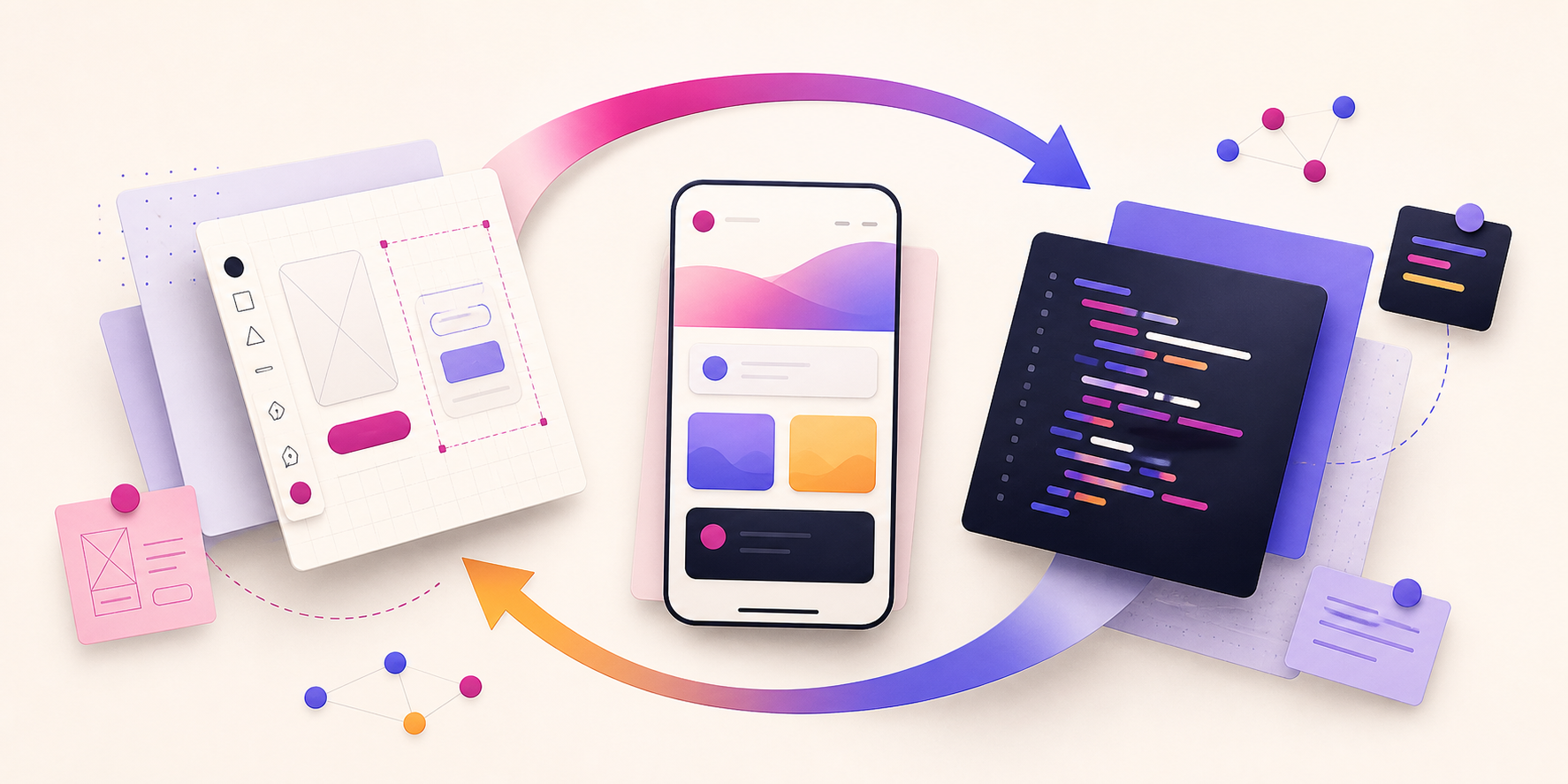
Figma is still valuable in this environment. It is simply not always the final destination. It becomes part of a faster loop: idea, prototype, code, feedback, and a better design.
The best design process is not the most documented one, and it is not the fastest one. It is the one that gives a team enough clarity to build the right thing—and enough speed to learn before the market moves on.
Documentation and speed are not opposites
It is easy to treat process as a choice between two extremes: document everything or move fast and skip the details. In practice, strong product design means choosing the right level of process for the risk.
A payment flow in a telecom product needs clear states, constraints, and cross-functional alignment. A new onboarding idea may only need a working prototype and a few user conversations before the team knows whether it deserves more investment.
The problem is not documentation. The problem is creating documentation that does not help a team make a better decision. The same is true of speed: shipping quickly is only useful when it helps a team learn something meaningful.
From Figma to code—and back again
The boundary between design and development is becoming less rigid. Designers can use code-based prototypes to test ideas faster, while live product interfaces can return to the design canvas for critique, iteration, and collaborative decision-making.
This is not about every designer becoming a developer. It is about designers becoming more connected to what gets built, how it behaves, and whether it creates value after launch. Figma describes this shift as a growing design-to-code loop, where the canvas and the running product inform each other instead of operating as separate worlds.
The capability to build in both worlds
As AI makes it easier to generate interfaces, code, and visual alternatives, the designer's judgment becomes even more valuable. The real advantage is not producing more screens. It is understanding what deserves to be built, what needs validation, and where a team should slow down or move faster.
- Use systems thinking when complexity demands alignment
- Use product judgment when speed and learning matter most
- Build enough technical literacy to collaborate closely with engineering
- Use prototypes to reveal assumptions, not only to present polished solutions
- Let customer behavior shape the next design decision
The best product designers are not defined by a tool or a handoff process. They are defined by their ability to create clarity when complexity demands it—and momentum when the product needs to learn.